10–25ms
Mumbai to Mumbai latency band
New Release: Managed Supabase Hosting in India from ₹499/mo with Dedicated VPS Architecture.
Know more →Also Available: One-Click Managed OpenClaw VPS from ₹749/mo. No yearly lock-in.
Explore OpenClaw →
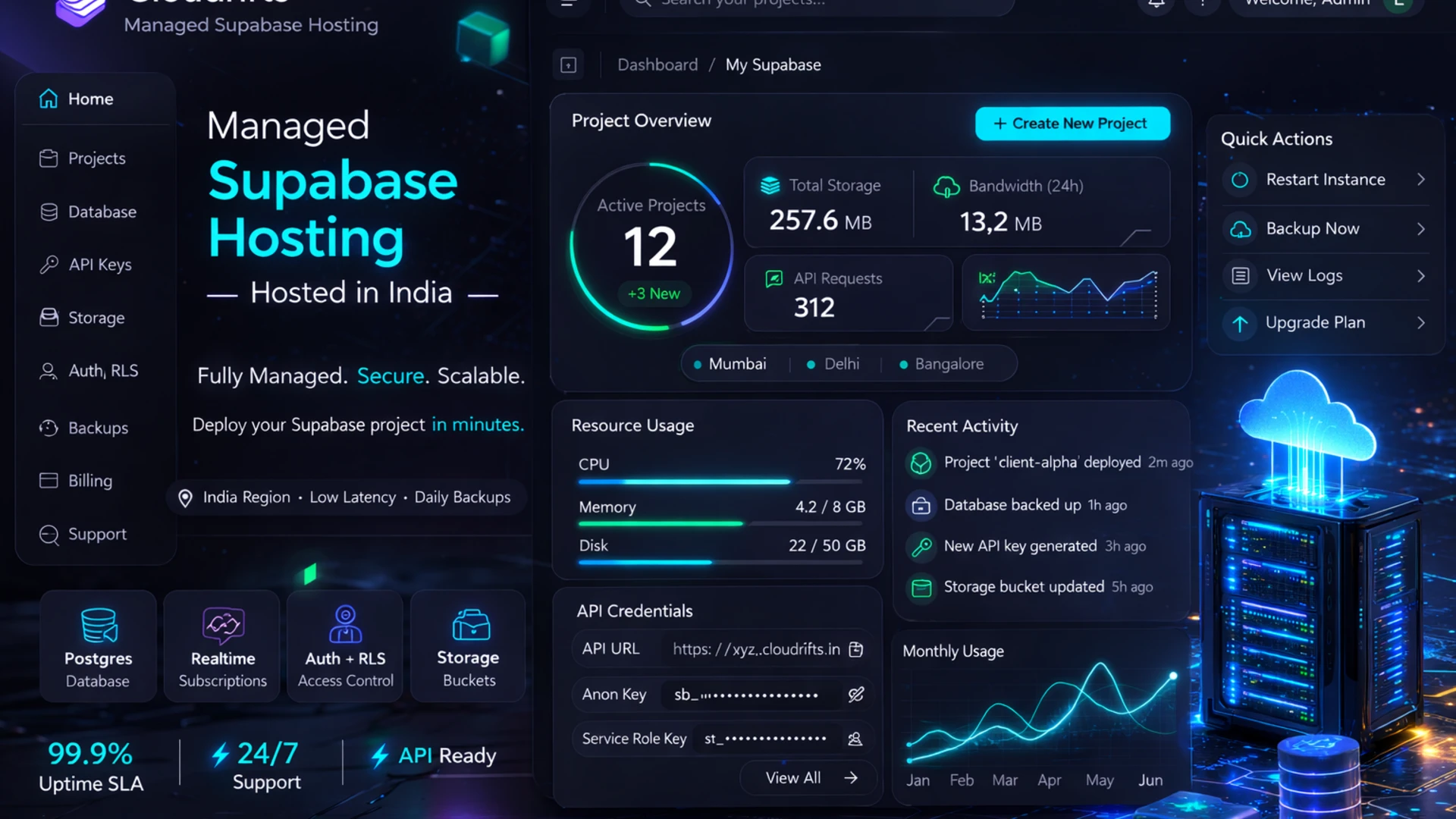
Managed Supabase Hosting in India
Production-ready Supabase infrastructure deployed in Mumbai and Bangalore with isolated RAM-based VPS architecture. Built for Indian SaaS teams that require stable routing, predictable performance, and zero DevOps overhead.
10–25ms
Mumbai to Mumbai latency band
99.9%
SLA on 8GB and 16GB plans
₹499/mo
Starting plan for managed Supabase
Managed
Migration, backups, monitoring included
If your users are located in India, cross-region routing instability can directly impact authentication flows, database transactions, realtime subscriptions, and object storage uploads. Even when upstream providers show healthy status pages, routing behavior between telecom providers and enterprise networks can introduce latency spikes, packet retransmissions, and websocket instability.
For production applications, these issues are not just performance annoyances. They affect sign-in reliability, background job completion, dashboard freshness, and the overall user trust your product depends on. Teams often spend engineering time debugging app code when the actual bottleneck is transport distance plus inconsistent network paths.
Production-grade SaaS applications require:
When backend infrastructure is geographically closer to your users, network volatility is significantly reduced. For architecture and operations trade-offs, read our detailed comparison of self-hosting vs managed Supabase in India.
These baseline numbers represent typical SaaS traffic patterns from Indian metro regions under mixed read/write workloads. Actual values vary by ISP path and payload size, but the spread is directionally consistent across production environments.
| Scenario | Average Latency |
|---|---|
| Mumbai → Mumbai | 10–25ms |
| India → Singapore | 70–110ms |
| India → US East | 180–250ms |
Lower round-trip latency is not only about fast API calls. It materially improves login responsiveness, reduces stale websocket state, and keeps product behavior predictable during high-concurrency windows.
| Feature | Supabase Cloud | Self-Hosted | Cloudrifts |
|---|---|---|---|
| India Region Control | Limited | Depends | Yes |
| Dedicated Isolation | No | Depends | Yes |
| DevOps Required | No | Yes | No |
| PITR Backup | Limited | Manual setup | Included |
| SLA | No | No | 99.9% (8GB+) |
| Routing Stability | External | Self-managed | India-optimized |
This comparison is less about feature checkboxes and more about operational burden. Self-hosting can be powerful, but you inherit patching, hardening, observability, and incident response. Managed VPS in India keeps backend control while removing day-to-day infrastructure overhead for product teams.
Plans are aligned for production growth, from 2GB MVP deployments to 16GB enterprise workloads. Use coupon CLOUDRIFTS-BASE-25 for 25% off your first month as a new user.
₹499 / month
2GB RAM • 1 vCPU • 20GB NVMe • Daily backups
Most Popular
₹999 / month
4GB RAM • 2 vCPU • 50GB NVMe • 7-day PITR
Production SLA
₹1,999 / month
8GB RAM • 4 vCPU • 150GB NVMe • 14-day PITR • 99.9% SLA
Enterprise
₹3,499 / month
16GB RAM • 8 vCPU • 300GB NVMe • Priority support • 99.9% SLA
Most teams compare only base compute pricing and underestimate operational line items. A realistic monthly total includes storage, snapshots, traffic transfer, and observability tooling before adding engineering time.
Estimated realistic monthly total: ₹4,000–₹6,000
This estimate excludes DevOps implementation time, troubleshooting cycles, security hardening work, and scaling coordination across services. For many teams, these hidden costs exceed raw infrastructure spend within the first few months.
Read the AWS Mumbai cost analysis for a deeper component-level breakdown.
Cloudrifts uses a dedicated deployment model where every customer stack is isolated at runtime, storage, and monitoring layers. This model is designed to remove noisy-neighbor behavior, reduce shared-failure blast radius, and keep performance predictable under uneven traffic profiles.
Each deployment includes:
Every deployment runs in its own PostgreSQL runtime with reserved CPU and RAM, so one project cannot consume resources allocated to another.
Each stack receives isolated Docker networking and routing boundaries, reducing lateral movement risk and containing noisy network behavior.
Data and object storage volumes are mapped per customer with quota controls, ensuring clean data isolation and predictable disk behavior.
JWT secrets, anon keys, and service role credentials are generated per instance and rotated during managed maintenance windows.
CPU and memory limits are enforced at runtime, which prevents cross-tenant starvation and keeps query latency stable under burst traffic.
Logs, health probes, and alert channels are scoped per deployment, helping incident response stay precise and reducing false positives.
Noisy-neighbor prevention is not a marketing phrase here. It is enforced through isolated process boundaries, independent network policy, strict cgroup controls, and monitoring separation that keeps incidents localized and diagnosable.
Plan sizing should be based on workload shape, not only total user count. Realtime fan-out, write bursts, background jobs, and dashboard concurrency all influence RAM pressure and connection behavior. Use this as a practical starting point:
MVP workloads and early products under 5k DAU with moderate read/write patterns.
Approximate websocket guidance: ~200 to 500 concurrent websocket connections depending on event fan-out.
Best for teams validating product-market fit and keeping infrastructure cost controlled.
Early production SaaS with regular auth traffic, dashboards, and background workers.
Approximate websocket guidance: ~500 to 1,500 concurrent websocket connections for steady collaboration workloads.
Balanced option for production apps that need room to grow without over-provisioning.
Growing apps using realtime heavily, frequent writes, and higher query concurrency.
Approximate websocket guidance: ~1,500 to 4,000 concurrent websocket connections with optimized event payloads.
Strong fit for customer-facing SaaS requiring SLA-backed uptime and lower p95 latency.
Enterprise workloads, multi-tenant architectures, and heavy analytics pipelines.
Approximate websocket guidance: 4,000+ concurrent websocket sessions with workload-specific tuning.
Recommended when sustained throughput and strict recovery objectives are non-negotiable.
Websocket guidance depends on event payload size and subscription topology. If your workload is event heavy, choose the next tier early to preserve lower p95 response time and better buffer headroom during peak traffic.
Migration support is included for new customers. Before cutover planning, review our step-by-step Supabase migration guide to align prechecks and rollback points.
Pick the plan, region, and expected workload profile. Provisioning usually completes in minutes.
Provide pg_dump output, project credentials, or exports for auth, storage, and environment variables.
Cloudrifts engineers restore data, map keys, validate APIs/auth/realtime/storage, and execute sync checks.
Endpoints are switched in a scheduled window with rollback-ready checkpoints to keep downtime minimal.
A successful migration is mostly about disciplined validation. Auth callbacks, storage paths, API contracts, and realtime channels are verified before traffic switch so production behavior remains predictable on day one.
Backup strategy must include both retention and recovery readiness. Cloudrifts combines scheduled snapshots with WAL-based recovery paths so teams can restore to a known-good point when incidents involve corruption, deletion, or deployment mistakes.
Automated full backups are stored off the primary runtime to protect against accidental deletion and host-level failures.
Continuous write-ahead log retention allows point-in-time recovery for incident response and corruption rollback.
Restore drills validate backup integrity so recovery procedures are tested before incidents, not during them.
RTO: 24 hours
RTO: 6 hours
RTO: 1 hour
RTO: Custom SLA
Recovery targets are reviewed against your traffic profile so backup policy, retention window, and restoration path stay aligned with business impact.
Security posture is built from layered controls rather than a single perimeter. Infrastructure is hardened for exposed surfaces, runtime behavior, key handling, and operational recovery so production workloads can remain resilient through expected failure scenarios.
Ingress rules are tightly scoped to required service ports only, reducing attack surface from unnecessary exposure.
Only approved endpoints are externally reachable. Internal services stay isolated behind proxy and network boundaries.
Managed SSL provisioning and renewal ensures encrypted traffic by default without certificate maintenance overhead.
Traffic routing and upstream controls are separated per deployment to improve containment and request hygiene.
Service credentials and JWT secrets are handled in controlled scopes, limiting leakage risk during operations.
Container restart policies plus log-based alerts reduce prolonged downtime and accelerate recovery actions.
This approach keeps security practical for product teams: fewer exposed ports, controlled secret surfaces, monitored runtime behavior, and structured response paths when anomalies are detected.
Managed Supabase hosting in India is best suited for applications where backend reliability affects user trust, revenue operations, or team velocity. If your product is moving from prototype to production, this model removes recurring infrastructure bottlenecks.
Great fit for B2B SaaS products that require consistent auth, stable API performance, and reliable realtime collaboration.
Supports high-concurrency student sessions, assignment workflows, and event-driven updates during peak class hours.
Useful for admin portals, catalog sync pipelines, and fulfillment dashboards that need predictable database behavior.
Lower latency to Indian users improves session consistency for mobile auth, background sync, and push-trigger workflows.
Works for operational systems where uptime, auditability, and controlled recovery processes are business critical.
Isolation and resource controls help maintain predictable performance across customer tenants and workload spikes.
This platform is intentionally designed for production use. If your current project does not need operational guarantees, a lower-touch setup may be more appropriate.
Explore these technical guides to evaluate architecture decisions, plan migration safely, and understand regional reliability behavior before production scale.
Detailed production comparison for cost, security, operations overhead, and reliability planning in India.
Read ComparisonStep-by-step migration process with backup planning, validation checkpoints, and safe cutover workflow.
Read Migration GuideRouting behavior analysis and practical mitigation options for Indian product teams running live traffic.
Read Outage AnalysisRated 5.0 ★ on Google – Trusted Hosting in India
★★★★★
“Awesome support late Saturday evening. Over and above the basic asks. Worked patiently to help me update my settings.”
★★★★★
“We’ve been hosting 3 of our websites with Cloudrifts for around 16 months now, and honestly it’s been a great experience.”
Trusted for WordPress Hosting, Shared Hosting, and Managed OpenClaw Hosting across India.
No. Cloudrifts provides managed self-hosted Supabase infrastructure using official open-source components.
Yes. Supabase client libraries, endpoints and authentication remain fully compatible.
Yes. Each instance runs in its own isolated container with dedicated database and storage.
Yes. You can scale RAM, CPU and storage anytime.
Yes. Migration is included for new customers.
Choose stable routing, predictable performance, and lower operational risk for your backend stack. Cloudrifts gives you managed infrastructure, migration support, and production-focused reliability without adding DevOps overhead to your product roadmap.